Horse Business Taxes: What Every Equine Owner Needs to Know

Owning horses is a passion — but when horses become a business, the IRS takes notice. Whether you operate a boarding stable, a training facility, a breeding operation, or a competitive performance barn, the tax rules that govern your equine business are nothing like those for a standard LLC or retail shop. Get them wrong, and you could face disallowed deductions, back taxes, or a costly audit.
This guide breaks down the most important tax concepts every horse business owner needs to understand — from the dreaded hobby loss rule to the deductions that can save you thousands each year.
The Hobby Loss Rule: Your Biggest Tax Risk
The single most important tax issue for equine business owners is IRS Section 183 — commonly known as the ‘hobby loss rule.’ This rule determines whether the IRS treats your horse operation as a legitimate business (where losses are fully deductible) or a hobby (where losses cannot offset other income).
The Presumption Test
For most businesses, the IRS presumes a profit motive if you show a profit in at least 3 out of 5 consecutive tax years. For horse breeding, training, showing, or racing, the IRS applies a more generous rule: you only need to show a profit in 2 out of 7 consecutive years. This reflects the reality that horse businesses often require years of investment before becoming profitable.
But simply meeting this test is not enough. The IRS also examines nine factors to determine whether you genuinely intend to make a profit:
- Whether you depend on the income from the activity
- The time and effort you put into the activity
- Whether you carry on the activity in a businesslike manner (separate accounts, books, contracts)
- Your expertise and background in the equine industry
- Your history of income and losses in the activity
- The amount of occasional profits earned, if any
- Your financial status — do you have significant outside income?
- Whether you have successfully converted a similar activity to profitability before
- Whether losses are due to circumstances beyond your control or normal startup costs
What Can Horse Business Owners Deduct?
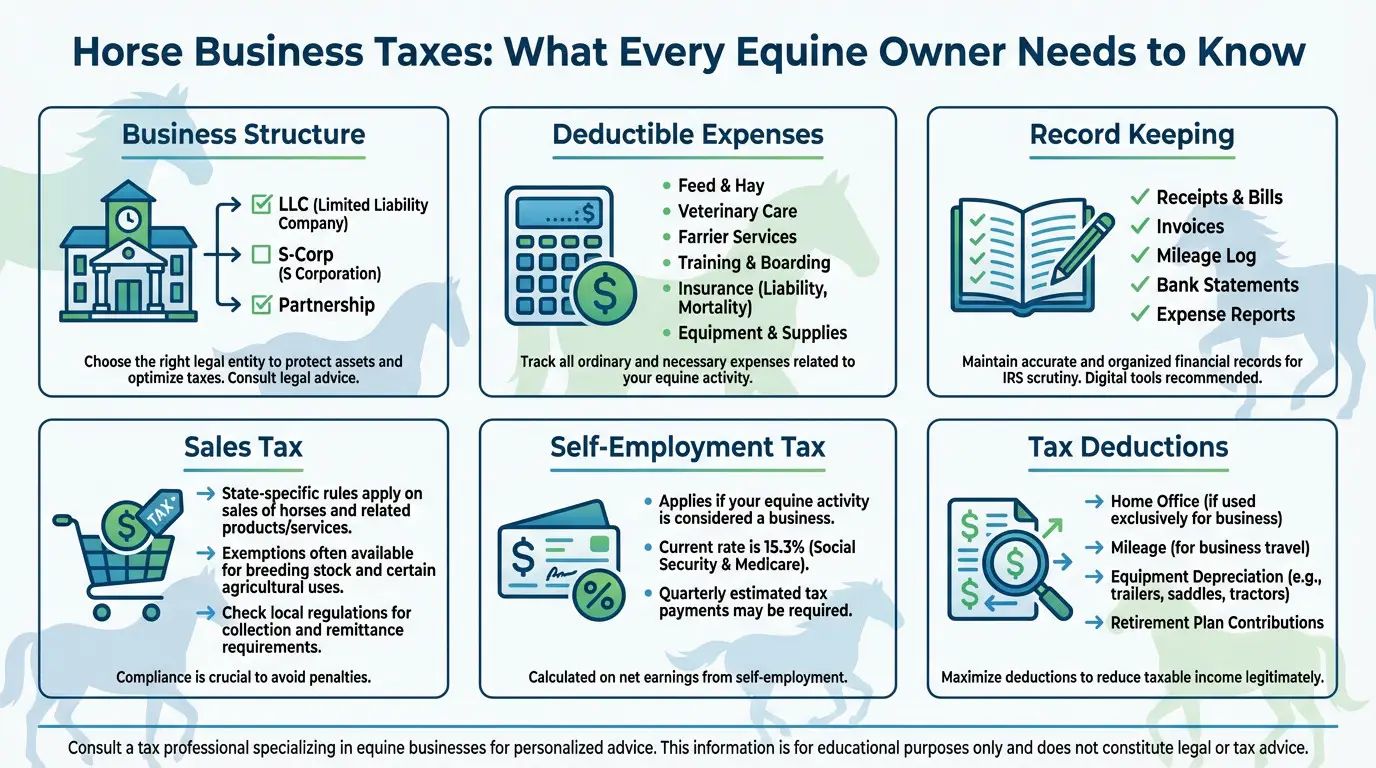
If your operation qualifies as a business (not a hobby), the list of allowable deductions is substantial. Here are the major categories equine business owners should be tracking:
1. Horse Care & Operating Costs
- Feed, hay, bedding, and supplements
- Veterinary care, farrier services, and dental work
- Grooming supplies and equipment
- Training fees paid to outside trainers
- Entry fees for competitions and shows
2. Facility & Property Expenses
- Barn maintenance, repairs, and improvements
- Fencing, arena footing, and facility upgrades
- Utilities (water, electricity) for barn and pasture operations
- Property taxes on business-use land
- Depreciation on farm buildings and improvements
3. Vehicles & Equipment
- Trucks, trailers, and ATVs used for the business
- Tractors and farm equipment
- Fuel, insurance, and maintenance on business vehicles
- Section 179 expensing or bonus depreciation on equipment purchases
4. Horses as Depreciable Assets
Horses used in a business — breeding stallions, mares, racehorses — can be depreciated. The IRS classifies most horses as 3-year property (racehorses under two years old at purchase) or 7-year property for other horses. With bonus depreciation, you may be able to deduct a significant portion of a horse’s cost in the year of purchase rather than spreading it over several years.
5. Insurance, Professional Fees & Travel
- Mortality, liability, and property insurance
- Accounting, legal, and consulting fees
- Travel to horse shows, sales, and industry events
- Subscriptions to equine industry publications and associations
Income You Must Report
Just as important as knowing your deductions is knowing what counts as taxable income. Equine business income includes:
- Boarding fees and training income
- Proceeds from the sale of horses (long-term capital gains rates may apply if held more than one year)
- Breeding fees and stud fees
- Prize money and performance bonuses
- Lease income from horses or facilities
Payroll Considerations for Horse Farms
If you employ grooms, trainers, barn managers, or other staff, you have payroll obligations that require careful attention. Agricultural workers are subject to different payroll tax rules than standard employees — including specific FUTA exemptions and varying state unemployment rules. Getting this wrong can result in penalties from the IRS and state tax agencies.
It is also critical to correctly classify workers as employees versus independent contractors. Many equine trainers and riders prefer contractor arrangements, but the IRS applies a strict economic reality test. Misclassification can trigger significant back taxes and penalties.
State-Specific Considerations
Tax rules for horse businesses vary significantly by state. Some key examples:
- Kentucky — No sales tax on horses used for breeding, racing, or showing, but specific exemption certificates are required.
- Texas — Feed, medicine, and farm equipment may be exempt from sales tax if you meet agricultural use requirements.
- California — Strict employment and payroll laws mean worker classification is especially high-risk.
- Florida — No state income tax, but property tax agricultural exemptions require active business documentation.
- North Carolina & Tennessee — Both states offer agricultural property tax exemptions but have different qualification thresholds.
This is one more reason why working with an accountant who serves equine clients across multiple states — rather than a local generalist — gives horse business owners a meaningful advantage.
Why a Specialist Accountant Matters
A general accountant can prepare your return — but an accountant who works with equine businesses does something different. They understand the full picture:
- How to document your profit motive so the IRS hobby loss rule never becomes a problem
- Which depreciation strategies maximize your tax savings each year
- How to structure income from horse sales to qualify for capital gains treatment
- Which state-specific exemptions and deductions you are entitled to claim
- How to handle payroll for agricultural workers correctly across different states
At Phoenix Accounting, we work with horse farm owners, trainers, breeders, and equine facility operators across California, Texas, Kentucky, Tennessee, North Carolina, Florida, and beyond. We understand the financial realities of the equine industry because it is a specialty we have built our practice around.
Ready to stop overpaying on your horse business taxes?
Book a free consultation with Phoenix Accounting today. We will review your current situation, identify missed deductions, and put a strategy in place that protects your business year-round.
📞 256-341-7724Book Your Free Consultation
This post is for informational purposes only and does not constitute tax or legal advice. Consult a qualified tax professional regarding your specific